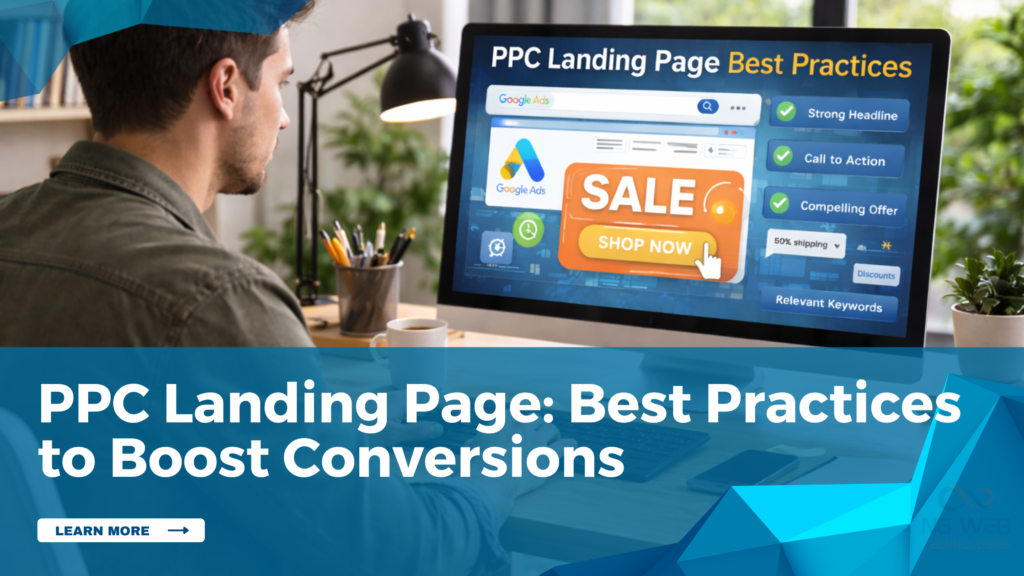
PPC Landing Page: Best Practices to Boost Conversions
PPC Landing Page: Best Practices to Boost Conversions A PPC Landing Page plays an important role in how well your paid ads perform. Even good advertisements can fail when your page is slow, hard to understand, or irrelevant to what users are expecting. A good PPC Landing Page should be clear, fast, and mobile-friendly. Using PPC landing page best practices helps users take action easily. With proper PPC Landing Page Optimization, you can increase conversions and get better results from your ads. Looking at real PPC Landing Page Examples and using effective PPC Landing Page Templates can also help you build high-performing pages more quickly. 1. Match Your Ad with Your Landing Page Your landing page must fulfill the promises made in your advertisement. Any mismatch between ad and page makes users feel misled and increases bounce rate. When users see the same offer, message, and tone, they feel confident and stay longer. Consistency is the foundation of a high-converting PPC landing page. Tips: Use the same heading or words used in your advertisement. Avoid sending users to a generic homepage Case Study A fitness brand in Atlanta ran ads for discounted treadmills, but users were sent to a general product page. Many visitors got confused and left without finding the offer. After creating a separate landing page for treadmills and clearly showing the discount, users are able to find what they want without any difficulties. Within a few weeks, the number of people who made purchases and spent more time on the page increased. 2. Use a Clear, Benefit-Focused Headline The first thing that users read on your page is the headline. It must clearly state what you offer in simple and easy language. An effective headline concentrates on the user’s benefit rather than the company name. This immediately builds interest and keeps users engaged. Tips: Keep the headline short and powerful Highlight one main benefit instead of many Case Study A digital marketing agency in Denver used an unclear headline that did not clearly explain its services. Many visitors left because they did not understand the page quickly. After changing the headline to focus on business growth and real results, the page became clear. A larger number of visitors remained on the page and completed the inquiry form. 3. Keep the Layout Simple and Clean A busy landing page distracts users from your main goal. A clean layout helps visitors focus on your message and CTA. Using white space, clear sections, and a simple design makes the page easier to read and use. This is an important part of PPC Landing Page Optimization. Tips: Avoid too many sections or pop-ups Write clear headings and short paragraphs Case Study A San Diego-based software company had a busy landing page with excessive text, graphics, and pop-ups. Users were confused and left quickly. Once the layout was simplified and the unnecessary elements were eliminated, the page became easier to read and navigate. The bounce rate was reduced, and the number of people requesting product demos increased. 4. Use a Strong and Visible Call-to-Action (CTA) Your Call-to-Action (CTA) is the most important part of your PPC Landing Page because it tells users what to do next. When your CTA is weak, hidden, or unclear, visitors will not take any action even though your page is good. A strong CTA should feel natural. It should clearly show the benefit of clicking, e.g. saving money, assistance, or receiving something valuable. Tips: Use action-based phrases like “Get Free Quote” Place the CTA where users can see it easily without scrolling Case Study A real estate brand in Orlando used a simple “Contact Us” button that did not explain any benefit. Many users ignored it. After changing it to “Book Your Free Property Tour,” the button became more attractive and meaningful. More people clicked and scheduled visits. 5. Optimize for Mobile Users Most PPC clicks now come from mobile devices, so mobile design is no longer optional – it is essential. A poor mobile experience can reduce conversions even if your ads perform well. A good mobile landing page must be fast to load and show content clearly. Scrolling should feel smooth, and forms should be short and easy to fill. Tips: Test your page on multiple phones Avoid short text and crowded layouts Case Study A Miami-based travel agency received a large number of mobile ad clicks but few bookings. Their page was mainly designed for desktop. Once the page was redesigned in a more mobile-friendly manner with larger buttons and a simplified form, navigation became simpler. The number of mobile users who completed booking forms increased. 6. Improve Page Loading Speed Page speed is one of the most critical factors in PPC Landing Page Optimization. Your page should not take too long to load; otherwise, users will leave before seeing your offer. Every second of delay increases bounce rate and reduces conversions. Fast pages create trust, improve user experience, and also help with Quality Score in paid ads. Tips: Compress images before uploading Use fast hosting and caching tools Case Study A Dallas-based e-commerce brand received many clicks but only a few sales, as its page loaded very slowly due to heavy images. Once the images were compressed and the speed of hosting increased, the page loaded more quickly. In one month, the number of users who made purchases increased. 7. Add Social Proof and Trust Signals People feel more comfortable buying from brands they already know. Social evidence can be used to minimise fear and uncertainty, which is highly valuable in a PPC landing page. Testimonials, ratings, client logos, and case results are examples of trust signals that help your page look credible. They show that people trust and use your products or services. Tips: Add real customer reviews Display ratings or success stories Case Study One of the consulting firms in Boston had a good landing page but lacked customer reviews and testimonials. A lot of visitors were afraid to submit
PPC Landing Page: Best Practices to Boost Conversions Read More »
Blog