
What is generative engine optimization (GEO) and how will it affect the SEO in future?
Digital marketing is evolving rapidly as AI tools become a common way for people to search. Users do not want to browse with numerous links; they want direct answers. This change has led to Generative Engine Optimization (GEO).
GEO makes content easier to understand and use by AI systems in providing answers. This makes it an important part of modern digital growth.
In this blog, we’ll explain what GEO is, how it is different from SEO, the GEO impact on SEO, and how businesses can build a strong GEO content strategy for the future.
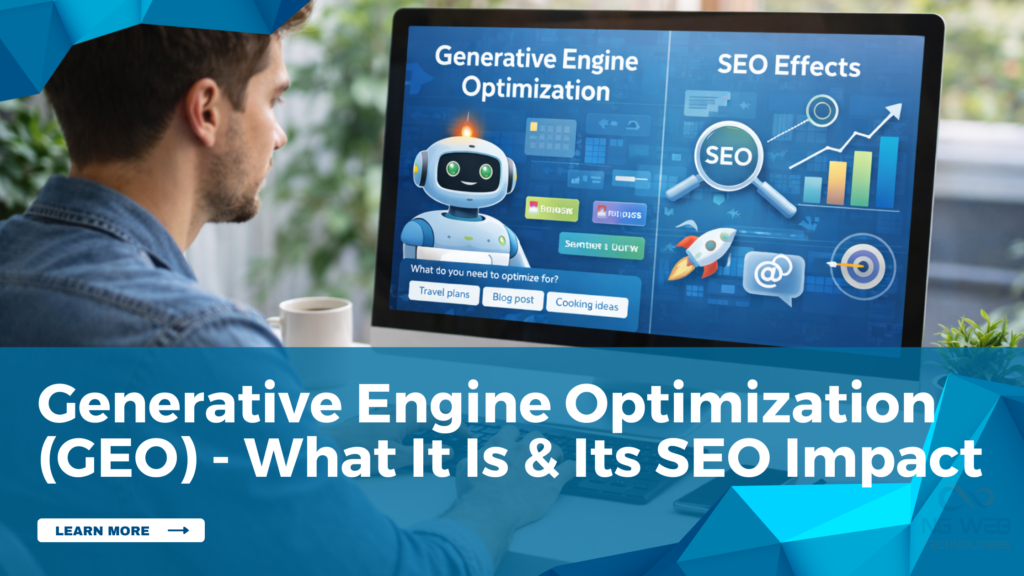
What Is Generative Engine Optimization (GEO)?
Generative Engine Optimization (GEO) refers to the act of making your content easily understood, trusted, and utilized by AI systems when they are generating responses to users.
In contrast to traditional SEO, which is primarily concerned with ranking webpages on search engine results pages, GEO focuses on making your content the source that AI tools rely on when generating their responses.
In simple terms, GEO assists in making your content a reliable source that can be summarised, quoted, or transformed into direct answers by AI platforms.
To put it simply:
- SEO helps in ranking your website
- GEO makes your content an essential part of the answer
This distinction is gaining significance as more people utilise AI tools instead of clicking through multiple search results.
Why GEO Is Gaining Importance Now
The primary factor making GEO important is the increasing use of AI-based search tools. Individuals no longer use only short-keywords to search. They are asking complete questions like:
- What is Generative Engine Optimization?
- How will GEO impact SEO in the future?
- Is GEO better than SEO?
Generative engines read a large amount of data and generate one well-organised answer. If your content is not optimised for this process, it might not even be visible at all, despite having a high ranking in traditional search.
This clearly shows the increasing GEO impact on SEO, where rankings alone no longer guarantee visibility.
GEO vs SEO: Understanding the Key Differences
Many marketers ask about GEO vs SEO. Although both of them are meant to make companies more visible, they operate differently.
Traditional SEO
- Focuses on keywords, backlinks, and technical optimization
- Tries to rank webpages in search results
- Encourages users to click through to websites
- Measures success using traffic, rankings, and CTR
Generative Engine Optimization (GEO)
- Concentrates on clarity, context, and credibility.
- Aims to get content used in AI-generated answers
- Often delivers value without requiring a website click
- Relies on authority, accuracy, and structured content
GEO does not replace SEO but works with it. A smart digital approach combines both into a balanced GEO SEO strategy.
How GEO Will Affect the Future of SEO
The GEO impact on SEO is already changing how businesses define success online. Previously, success meant being ranked on the first page of Google. Now, it also means becoming a trusted source that AI platforms use when answering questions.
These are 5 significant ways GEO is transforming the future of SEO
1. SEO Will Shift From Rankings to Providing Direct Answers
Ranking on Google will remain important, yet it will not be the only goal. AI tools prioritize content that gives the most clear and complete answers. Websites which actually provide solutions will be seen more than those that are simply about rankings.
Case Study
One California-based SaaS brand had observed a reduction in Google clicks but an increase in brand mentions in AI chat applications. After rewriting their content with clear answers and better formatting, their visibility improved overall on AI platforms.
2. Quality of Content Will Be More Important than Keywords
GEO reduces the value of keyword stuffing and low-quality content. AI systems prefer natural, readable, and useful content. High-quality content establishes long-term credibility with both users and AI platforms.
Case Study
A marketing agency in Texas has substituted keyword-heavy blogs with simple and well-structured information. In a few months, their pages were referenced more often by AI tools, and user trust increased.
3. Authority and Trust Will Become Core SEO Signals
AI platforms rely on trustworthy sources. Generative engines will prefer content that is written by specialists and supported by practical experience and factual data.
Case Study
A healthcare information platform in New York added expert authorship, verified sources, and regular updates. AI tools began using their content more frequently, strengthening their authority.
4. SEO Will Become More Focused on User Intent
Future SEO will be less about exact keywords and more about understanding what people actually desire to receive, whether it be information, a product, or a solution.
Case Study
One of the Florida-based education platforms restructured the content based on users’ common queries. The visibility of AI improved, and the involvement was enhanced.
5. Structured Content Will Become the New SEO Standard
When the work is organised in a clear manner by using headings, bullet points and short paragraphs, the AI tools read it better. A good structure will allow readers and AI to understand information more efficiently.
Case Study
An Illinois-based consulting firm reformatted its website using FAQs and organised sections. Their content began appearing more often in AI-generated answers.
Building an Effective GEO Content Strategy
To remain competitive, companies have to alter their content creation strategy. The goal is to build a strong GEO content strategy while still following SEO basics.
1. Write for Humans First
Always write for actual people and not for the search engines alone. The content must be natural, friendly, and easy to understand. AI tools will trust and use your content more when it is human-written and helpful.
2. Answer Questions Clearly and Directly
Find out what questions people usually ask and answer them clearly in your content. When answers are simple and direct, AI systems can easily pick them for their responses.
3. Provide Context and Depth
Do not give only short answers. Explain things properly. Tell readers why something is important and how, not just what it is.
4. Use Logical Structure
Arrange your content into clear sections with significant headings. This makes it easier for readers to scan and for AI tools to understand your content.
5. Maintain Accuracy and Credibility
Always verify your facts and do not provide false information. With accurate and trustworthy content, the AI systems would be more comfortable using it in their responses.
Benefits of Generative Engine Optimization
Using GEO brings many positive results for businesses and content creators.
1. Enhanced Brand Visibility
Your brand can still feature in AI-generated responses even when the users have not visited your website. This makes more people notice and have confidence in your brand.
2. Future-Proof Content Strategy
As AI search becomes more popular, GEO keeps your content useful and easy to find in the future.
3. Stronger Authority Positioning
When your content is represented in AI responses, it shows that your brand is an expert in your area. This generates trust and credibility in the long run.
Challenges and Risks of GEO
GEO also comes with some challenges that businesses must understand.
1. Limited Performance Tracking
It is harder to measure GEO success compared to traditional SEO. You may not always know how often your content is used by AI tools.
2. Reduced Website Traffic
Because users get answers directly from AI, fewer people may click on websites. This means businesses must think beyond just website traffic.
3. Increased Competition
More brands are now trying to appear in AI-generated answers. This enhances the level of competition and compels all people to produce content of a higher quality.
Final Thoughts: Is GEO the Future of SEO?
GEO is not replacing SEO – it is reshaping it. The companies that innovate fast will establish greater authority, superior content, and long-term success.
Understanding what GEO is and implementing a smart GEO Content Strategy will keep your brand competitive in the future of digital marketing.