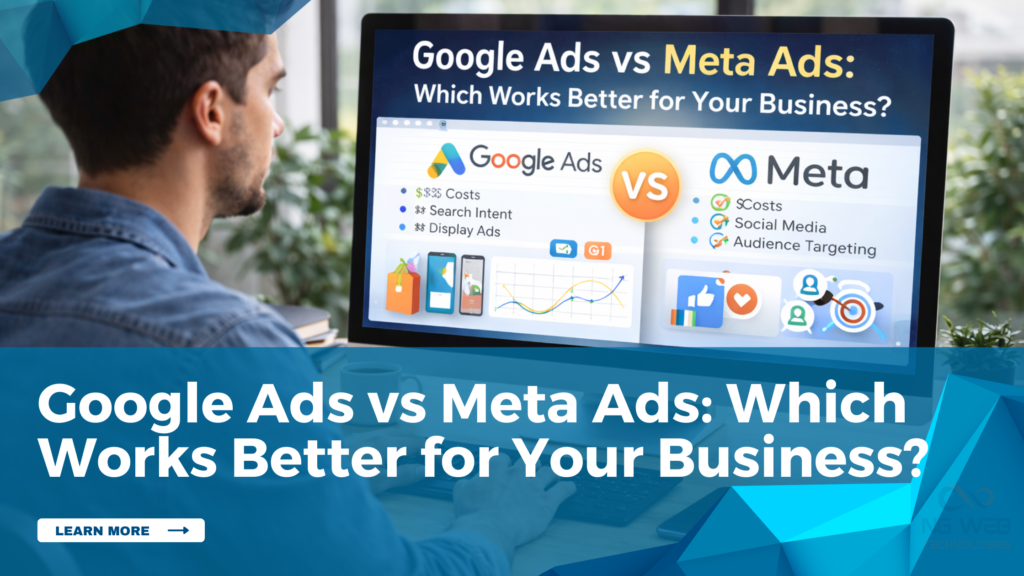
Google Ads vs Meta Ads: Which Works Better for Your Business?
One of the quickest methods of reaching potential customers on the internet is through paid advertising. However, many businesses struggle with one common question: Google Ads vs Meta Ads – which one is better?
Both platforms are powerful, but they work in very different ways. Google search advertising targets people who are actively searching, while Meta social campaigns reach people based on interests and behaviour. Because of this difference, returns from Google and Meta campaigns can vary depending on your business goals.
In this blog, we will break down this paid marketing comparison in simple terms. You’ll learn how both platforms work, their costs, lead quality, ROI, and how to choose the best paid promotion platform for businesses.
What Are Google Ads?
Google Ads is an online advertising platform where companies place promotional listings on search results, YouTube, Google Display Network, and partner websites. These paid campaigns appear when a user is directly searching for something about your product or service.
As an example, when a person enters the query, best digital marketing agency near me, Google’s advertising system will enable your company to be at the top of the ranking.
Key Features of Google Ads
- Search-based campaign targeting (higher intent users)
- Pay-per-click (PPC) model
- Text, display, video, and shopping formats
- High emphasis on keywords and user intent
This platform works best when people understand what they desire and are looking for a solution.
What Are Meta Ads?
Meta Ads allow companies to place sponsored content on platforms such as Facebook, Instagram, Messenger, and Audience Network. Unlike search-based platforms, these promotional campaigns do not rely on search intent. Rather, they concentrate on targeting the audience.
You can show promotional content to individuals based on:
- Age and location
- Interests and behaviour
- Online activity and engagement
This makes Meta-based advertising ideal for brand awareness, engagement, and demand generation.
Key Features of Meta Ads
- Creative and visual-based campaigns
- Behaviour-based and interest-based targeting
- Image, video, carousel, and story formats
- Strong for retargeting and brand building
Google Ads vs Meta Ads: Which Works Better for Your Business?
In order to see the real difference between the returns of both platforms, it is worth comparing both platforms on major factors. Below is a clear paid promotion comparison to help you decide.
1. User Intent
Search-based campaigns target those who are actively seeking a solution, while social platforms target those who are just browsing content and learning about new brands. This is one of the key reasons for comparing Google Ads vs Meta Ads to decide which advertisement platform suits your business.
Search engine campaigns tend to be more effective if your business relies on urgent needs. Social media promotions are more effective in situations where awareness, discovery, and initial interaction are required.
Tips:
- Use Google Ads for urgent or problem-based searches
- Use Meta Ads to introduce your brand early in the customer journey
Case Study:
A home services company in Houston ran search campaigns for emergency plumbing searches. They started receiving calls within a few hours from people who needed urgent help.
Later, the same company used social media promotions to show content to homeowners in Houston. When users faced problems later, they remembered the brand and searched for it again.
2. Speed of Results
Search-driven promotions generally deliver faster results because users already know what they want. Social platform campaigns take more time as users need repeated exposure before taking action.
When measuring campaign performance, speed plays a major role for businesses that need immediate leads or sales.
Tips:
- Choose Google Ads if you need quick leads
- Use Meta Ads for long-term growth and visibility
Case Study:
A home cleaning service in Texas started using Google Ads to get quick bookings. Within two days, people who were already searching for cleaning services contacted them.
They also ran social platform promotions at the same time. These advertisements required more time to attract inquiries, but after a few weeks, the number of individuals who became aware of the brand increased and began contacting.
3. Cost and Budget Control
Social platform campaigns tend to be cheaper to use, which is why they can be used by businesses with a limited budget. The cost of Google Ads can be higher, particularly in competitive markets, but it may provide higher-quality leads.
This paid ads comparison shows that cost alone should not decide the platform; return and lead value matter more.
Tips:
- Use Meta Ads when working with a smaller budget
- Use Google Ads when each lead has high revenue potential
Case Study:
A Phoenix-based eCommerce startup used social media promotions with a small daily budget to test various creatives. This helped them understand customer interest without high costs.
A professional services firm in the same city invested in search-based campaigns. Even with higher costs, they gained quality leads and closed profitable deals.
4. ROI Potential
When businesses learn about costs, ROI, lead quality, and which delivers better results, they often find that Search-focused promotions generate quicker returns. Social platform promotions usually deliver stronger ROI over time through regular interaction with the audience.
Google and Meta campaign ROI depend on whether your focus is on short-term sales or long-term brand growth.
Tips:
- Use Google Ads for faster ROI
- Use Meta Ads to improve long-term customer value
Case Study:
A California-based coaching business utilized search-driven campaigns to reach out to users who were searching for coaching services. This resulted in rapid registrations and payments.
At the same time, Meta Ads retargeted website visitors. Over time, repeat engagement improved, and overall customer value increased.
5. Lead Quality
Search-based promotions are usually associated with high-quality leads, as the user is actively searching. Social platform leads may take time and follow-ups before converting.
Understanding lead quality helps in deciding the most appropriate advertising platform to use in your business.
Tips:
- Use Google Ads when lead quality is critical
- Use Meta Ads to build interest and retarget users
Case Study:
A real estate consultant in Orlando found that search-driven leads were ready for property visits and serious discussions.
Social promotions generated interest-based leads who needed follow-ups. With regular follow-ups, these users gradually came closer to making decisions.
6. Brand Recognition and Engagement
Social platform promotions work well in brand recognition, visual narration, and interaction. Search-based promotions are more concerned with direct responses like calls and purchases.
This difference explains how search ads vs social media ads work at different stages of the buyer journey.
Tips:
- Use Meta Ads for engagement and brand storytelling
- Use Google Ads to make direct sales and enquiries
Case Study:
One fashion brand in Los Angeles has utilized Meta Ads, including images and short videos, to promote a new collection. Users engaged through liking and sharing posts.
Later, search-based campaigns captured users who were searching for the brand name. This helped turn awareness into direct online sales.
7. Retargeting Power
Social platforms offer strong retargeting opportunities both on Facebook and Instagram, whereas search-based retargeting is more restrictive, but purpose-oriented.
The combination of these two platforms can enhance the effectiveness of the campaigns.
Tips:
- Create powerful retargeting campaigns using Meta Ads
- Combine Google Ads to capture repeat search intent
Case Study:
An online course creator in Chicago noticed many visitors left the site without enrolling. These users were retargeted with reminders through social promotions.
Users went back and registered after seeing the ads several times. Later, search-driven campaigns captured repeat intent and boosted conversions.
Strategic Recommendations
To choose the best paid advertising platform for business, consider the following recommendations:
- Google Ads should be used on high-intent searches and quick leads
- Engagement and awareness should be done using Meta Ads
- Track conversions, not clicks alone
- Test ads regularly and optimize performance
Most successful companies utilize both platforms in order to balance between short-term and long-term outcomes.
Conclusion
The debate around Google Ads vs Meta Ads does not have a one-size-fits-all answer. Google Ads works best to attract users who are actively searching, whereas Meta Ads works best to attract users when they are trying out new brands.
The distinction between search-based campaigns and social promotions can assist you in selecting the appropriate strategy. Many businesses are growing by integrating both instead of selecting one platform.
By matching your goals, budget, and audience with the appropriate platform, you can enhance performance, gain visibility and maximize returns from paid advertising.