What Common Problems Do Businesses Have with Their Websites?
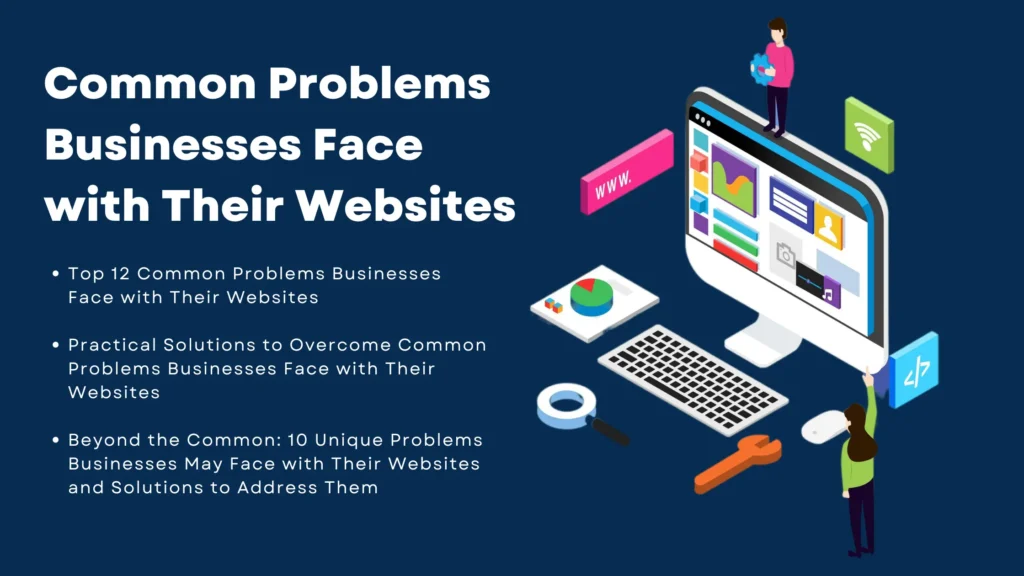
In today’s digital age, a website is often the first point of contact between a business and its potential customers. However, many businesses face a variety of challenges with their websites that can hinder their ability to attract, engage, and convert visitors into customers. In this blog, we’ll explore the common and unique problems that businesses encounter with their websites and provide detailed solutions to address these issues. Top 12 Common Problems Businesses Face with Their Websites 1. Not Converting Website Visitors into Customers Low conversion rates on key actions such as purchases or inquiries:Conversion rates are often affected by poorly designed conversion funnels, unclear calls-to-action (CTAs), and a lack of trust-building elements like testimonials or secure payment icons. Visitors may abandon the site if they encounter complicated checkout processes or find insufficient information about the products or services. Lack of compelling calls-to-action (CTAs) leading to visitor indecision:CTAs are crucial in guiding visitors toward desired actions. If CTAs are vague, poorly placed, or not convincing enough, visitors might hesitate or fail to take action, leading to missed conversion opportunities. Effective CTAs need to be clear, prominent, and encourage immediate action. 2. Poor User Experience (UX) On Website Slow website loading times cause high bounce rates:Websites with slow loading times experience higher bounce rates as visitors lose patience and abandon the site. This can be due to large file sizes, unoptimized images, or inefficient server configurations. A fast-loading site is crucial for retaining visitors and reducing bounce rates. Poor navigation structures lead to user confusion:Websites with complex or cluttered navigation make it difficult for users to find information quickly. Confusing menus, excessive dropdowns, or lack of clear pathways can result in a poor user experience and increased bounce rates. Clear and intuitive navigation helps users find what they need without frustration. Poor mobile optimization impacting usability on smartphones and tablets:With the increasing use of mobile devices, websites must be fully responsive and provide a seamless user experience across all screen sizes. Poorly optimized mobile experiences, such as small text, inaccessible menus, or slow loading times, can drive mobile users away. Complex forms deterring user submissions:Lengthy or complicated forms can discourage users from completing and submitting them. Forms with too many required fields, confusing instructions, or poor design can lead to form abandonment, resulting in lost leads or customer information. Lack of accessibility features excluding users with disabilities:Websites that do not adhere to accessibility standards (such as WCAG) can exclude users with disabilities from accessing content. Features like screen reader compatibility, keyboard navigation, and alternative text for images are essential for creating an inclusive user experience. Neglecting accessibility not only alienates a significant portion of potential users but also poses legal risks. 3. Not Generating Website Traffic Difficulty attracting relevant visitors through organic search (SEO):This challenge arises when the website’s content, keywords, and SEO practices are not effectively optimized for search engines. Lack of proper keyword research optimized meta tags, and quality backlinks can hinder organic search rankings. Limited visibility and reach on social media platforms:Businesses may struggle to build a strong presence on social media due to ineffective content strategy, inconsistent posting schedules, or inadequate engagement with followers. This limits their ability to drive traffic from social channels to the website. Challenges in running effective paid advertising campaignsDigital advertising ads requires careful targeting, compelling ad creatives, and optimized landing pages. Businesses often face challenges such as high cost-per-click (CPC), low conversion rates, or poor ad performance due to incorrect targeting or ad copy that doesn’t resonate with the audience. 4. Poor Content Quality and SEO On the Website Inconsistent publishing schedule affecting visitor engagement:Websites that do not regularly update content may fail to keep visitors engaged and fail to attract return visits. Inconsistent publishing can also impact SEO efforts, as search engines prioritize fresh and relevant content. Content not optimized for search engines, leading to poor visibility:Content that lacks proper Google SEO optimization—such as relevant keywords, meta tags, and internal linking—may struggle to rank high in search engine results pages (SERPs). This can reduce organic traffic and significantly limit your website’s online visibility. Thin or outdated content reduces user interest and return visits:Outdated content can diminish credibility and relevance in the eyes of visitors. It may also impact SEO negatively, as search engines prioritize fresh and current content in their rankings. 5. Security Vulnerabilities for the Website Vulnerabilities such as lack of HTTPS encryption:Websites without HTTPS encryption are vulnerable to data breaches and security threats, as sensitive information transmitted between the user and the server is not encrypted. This can undermine trust and result in loss of customer confidence. Risks of data breaches due to outdated software and plugins:Outdated software and plugins can contain vulnerabilities that hackers exploit to gain unauthorized access to the website or user data. Regular updates and security patches are essential to mitigate these risks. Lack of robust firewall and security measures against cyber threats:Websites without robust firewall protection and security measures are more susceptible to attacks such as DDoS (Distributed Denial of Service) or malware infections. Implementing strong security protocols is crucial to safeguarding sensitive information and maintaining website integrity. 6. Not Mobile Responsive Website Non-responsive design causing usability issues on mobile devices:Websites that are not optimized for mobile devices may have layout issues, small text, or inaccessible features on smaller screens. This can frustrate mobile users and lead to higher bounce rates. Inconsistent user experience across different screen sizes:Inconsistent user experiences across various devices (e.g., smartphones, and tablets) can impact usability and user satisfaction. Design inconsistencies may confuse users and hinder navigation. Difficulty in accessing and navigating website features on mobile:Mobile users may encounter difficulties in accessing certain website features or completing actions such as filling out forms or making purchases. Poor mobile optimization can lead to a loss of potential customers who prefer browsing on mobile devices. 7. Lack of Competitive Edge Challenges in defining and communicating a unique value proposition (UVP):Businesses may struggle to articulate what sets them apart from competitors and why
What Common Problems Do Businesses Have with Their Websites? Read More »
Blog